Top 5 Everyday Habits That Improve Posture (And Actually Prevent Back Pain)
“I have terrible posture” is one of the most common confessions I hear in the clinic. It’s frustrating, it’s annoying, and it often feels like an impossible habit to break. You notice you're slouching, you force your shoulders back, and ten minutes later, you're right back where you started. If this sounds familiar, you’re not alone — and there’s a very real reason it’s happening.
Poor posture isn’t random, and it certainly doesn't mean you're just lazy. It’s a sign that your body is adapting to the positions it spends the most time in. If you spend hours locked in a single, flexed position, your system struggles to adapt. And the good news is that once you understand how to change those inputs, you can actually do something about it.
Most people assume they just need a posture brace or a fancy new ergonomic chair. Sometimes changing your environment helps, but more often, the issue is deeper. Your body relies on subtle movement, fluid dynamics, and joint mobility to stay upright effortlessly. When you lack those, your body compensates. Instead of sitting tall naturally, you have to fight gravity.
If you really want to know how to improve posture and focus on true back pain prevention, you have to look at your daily habits. Here are five things that actually make a difference:
1. Fix Your Desk Setup Proper desk worker posture isn't about being perfectly rigid; it's about reducing mechanical stress. Keep your monitor at eye level and your feet flat on the floor. If your setup forces you to constantly reach or look down, your body has no choice but to mold to that restriction.

2. Break the Pattern Staying in one "perfect" position for eight hours is still detrimental. Your tissues need to hydrate and your joints need to move. Try to stand up or move for 30 seconds every 30 minutes. It shifts your nervous system out of that locked, protective mode and keeps your body from stiffening up.
3. Open the Front We spend our lives reaching forward — driving, typing, cooking. This makes the anterior chain (like the chest and hip flexors) incredibly tight, which pulls you forward. Try a simple doorway stretch for your chest, or a kneeling lunge for your hips. When you open the front, you stop fighting yourself just to stand straight.
4. Strengthen the Back Stretching is only half the equation. You need to build the structural capacity to hold yourself up. Whether it's doing rows, planks, or grabbing a kettlebell in your home gym for some deadlifts, strengthening your posterior chain gives your body the resilience it needs to cope with gravity.
5. Lift Your Screens Generic posture tips often ignore the phone. When you tilt your head down to scroll, the mechanical load on your neck skyrockets. Bring your phone up to eye level instead. It’s a small change that drastically reduces daily irritation on your cervical spine.

In Barrie, I see postural strain spike constantly as people shift into heavy work-from-home periods, long commutes, or increased screen time. These patterns build quietly over time. Maybe your upper back is doing too much work because your mid-spine is restricted. Maybe your ribs are stiff, so your neck has to compensate just to keep your head level.
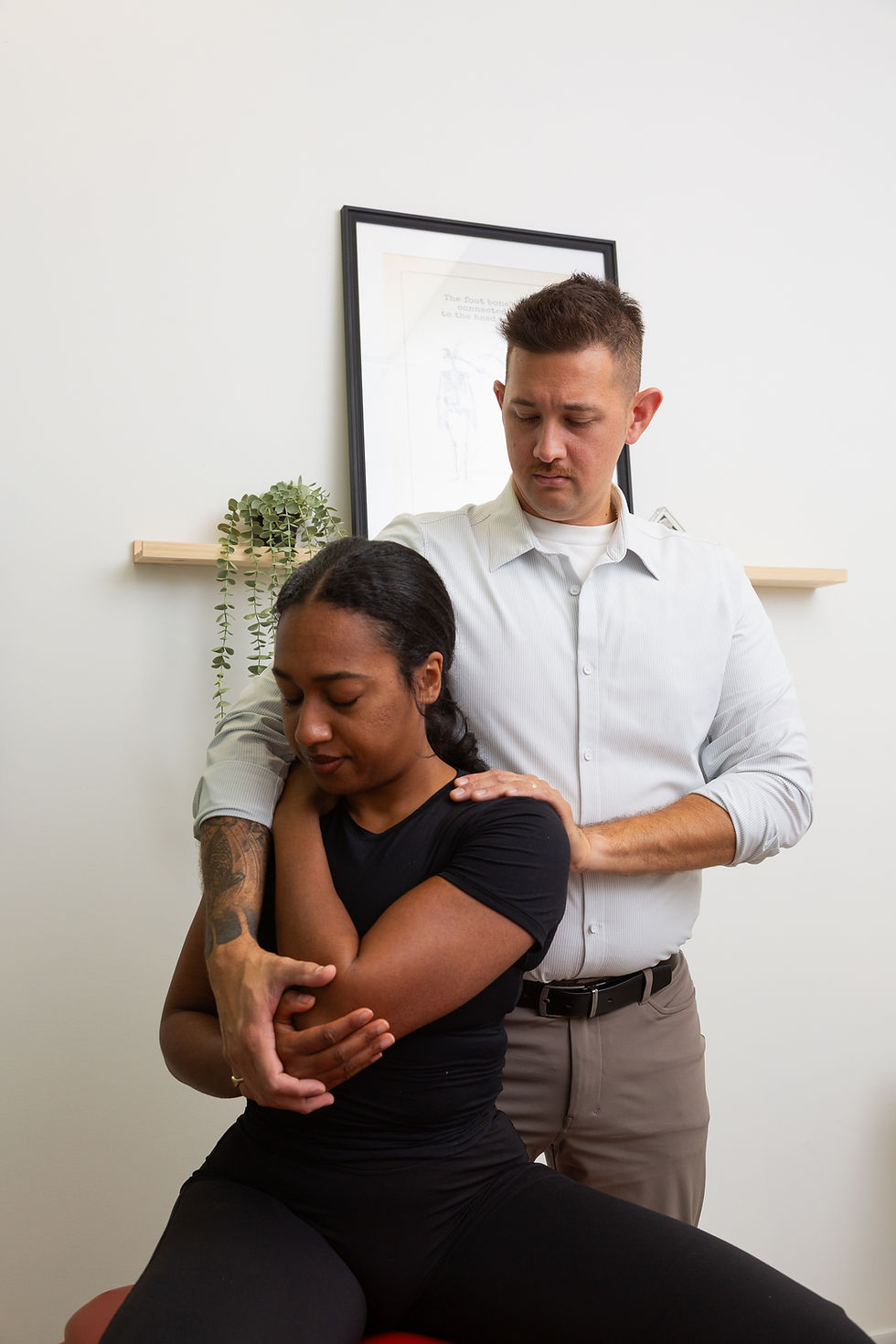
Osteopathic manual therapy is designed for exactly this kind of problem. Before opening The Osteo Lab, I spent 16 years as a paramedic, so I know exactly what long shifts, heavy loads, and mechanical stress can do to a body. When I assess someone dealing with postural pain, the goal isn’t to force your shoulders back or “crack” you into alignment. It’s to restore balance and mobility so your body can actually support itself naturally, instead of fighting itself.
When your system moves better, sitting up straight doesn't feel like a workout.
If you’re constantly fighting your own posture, it’s not something you need to just live with. It’s your body asking for help. And once you address the underlying restrictions, the change can be surprisingly fast.
If you’re in Barrie and you’re dealing with this, you’re exactly the kind of person I help every day. You don’t need an uncomfortable brace. You don’t need to stretch for an hour. You just need your system to move the way it’s supposed to.
Your posture can feel different — and your body can too.


Comments